For enthusiasts looking to import Japanese Domestic Market (JDM) powerplants, navigating the maze of legal requirements can feel daunting. If you are researching JASMA compliance requirements for JDM engine swaps, you likely already understand the appeal of these high-performance engines, but you may be less clear on how they interact with U.S. federal and state emissions laws. It is a common misconception that JASMA certification is a "golden ticket" for road legality in the United States. In reality, while JASMA serves as a trusted benchmark for exhaust quality and noise suppression in Japan, it does not equate to EPA or CARB approval for street use.
In this guide, we will clear up the confusion regarding JASMA regulatory compliance for imported vehicles and walk you through the essential steps for a successful, legal engine swap. You will learn the technical differences between JDM and U.S.-spec systems, how to handle the documentation required for registration, and the practical realities of passing state inspections. By understanding the distinction between aftermarket standards and federal mandates, you can ensure your build is not only powerful but also compliant with local regulations.
1. Understanding JASMA Compliance Requirements for JDM Engine Swaps and U.S. Federal Law

1.1 The Role of JASMA Certification vs. U.S. Emissions Mandates
For many enthusiasts, the appeal of a Japanese Domestic Market (JDM) engine swap lies in the potential for increased performance and reliability. However, confusion often arises regarding the legal status of parts labeled with JASMA certification. It is crucial to understand that JASMA acts as an independent Japanese aftermarket standard, focusing primarily on noise levels and build quality for performance exhaust systems. While JASMA certification ensures that an exhaust component meets specific Japanese noise regulations, it carries no weight with the U.S. Environmental Protection Agency (EPA).
The fundamental disconnect lies in the regulatory philosophy between the two nations. Japanese environmental testing prioritizes specific noise and performance benchmarks for the domestic market, whereas the EPA and state-level authorities, such as the California Air Resources Board (CARB), enforce stringent emissions mandates. Because the EPA does not recognize JASMA or other Japanese aftermarket standards, a JASMA-stamped component is not automatically considered legal or compliant for street use in the United States. Owners must look beyond these labels to ensure their setup adheres to local environmental laws, as explored further in our guide to JASMA regulatory compliance for imported vehicles.
1.2 Federal and State Legal Frameworks
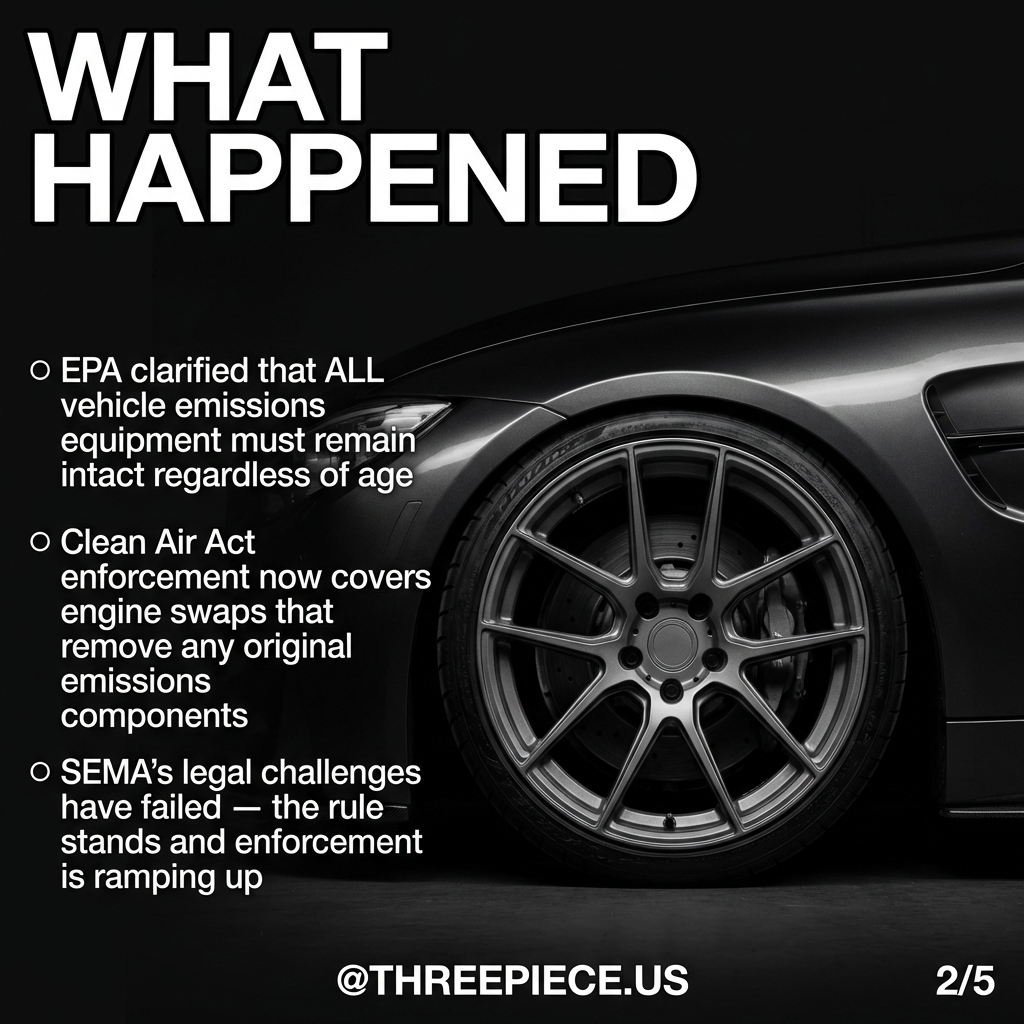
Navigating the legal landscape for engine swaps requires understanding the hierarchy of regulations. At the federal level, the EPA strictly regulates engine replacement policies. According to these rules, a swapped engine must be of the same class and model year (or newer) than the original, and it must retain all original emissions equipment. Even in states without mandatory annual emissions testing, the federal Clean Air Act prohibits the removal or tampering of emissions control devices, which technically renders most JDM swaps non-compliant for public road use if they lack these systems.
California represents the most rigorous environment for builders. The CARB certification process requires that any engine change undergo a formal referee inspection to ensure the engine and all its supporting emissions systems are functional and correctly matched to the chassis. In states with less stringent oversight, enthusiasts often mistakenly believe they are exempt from compliance. However, even in non-emissions states, operating a vehicle with a modified or swapped engine that lacks proper certification can lead to significant legal risks, including vehicle impoundment or heavy fines if the car is flagged for non-compliance during a roadside stop.
1.3 Technical Discrepancies Between JDM and U.S. Spec Engines
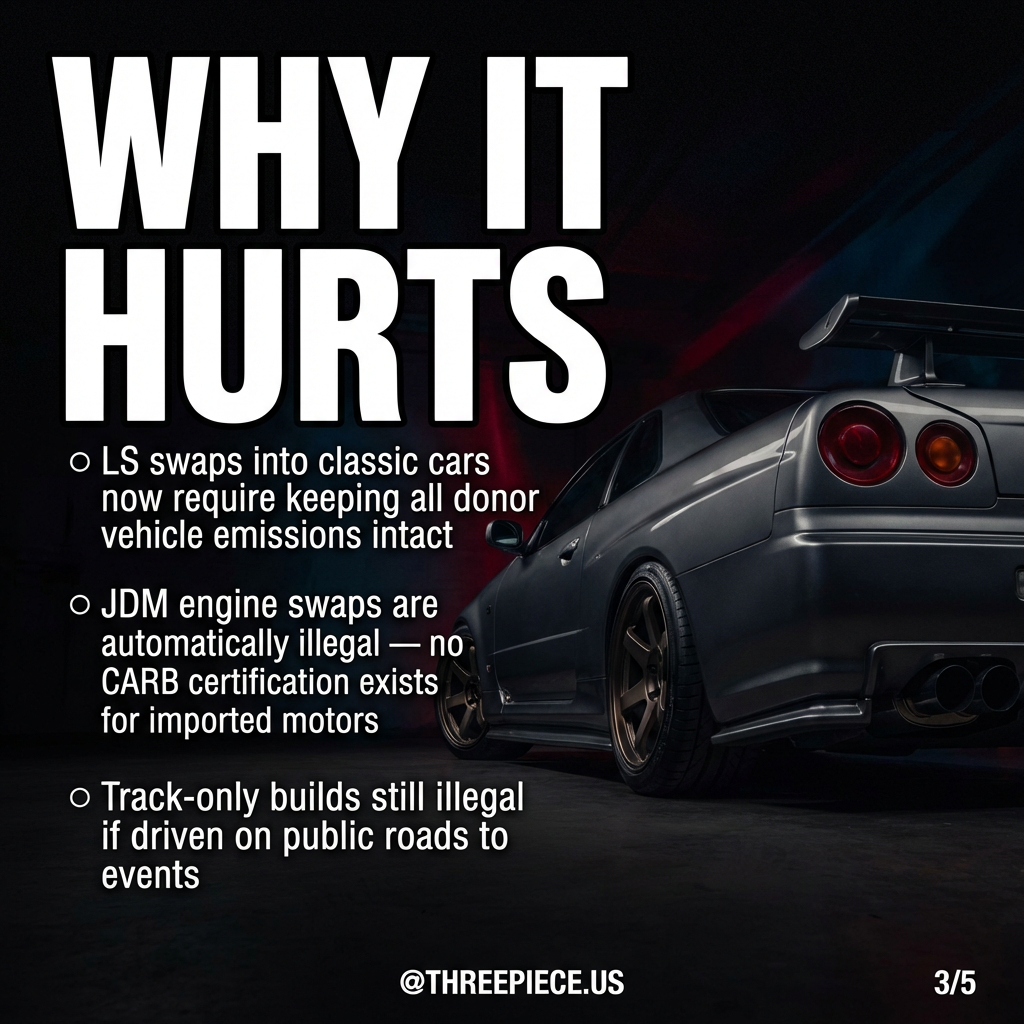
Beyond the paperwork, the physical and mechanical differences between JDM and U.S.-spec engines present the greatest hurdles for compliance. JDM engines were designed for fuel and emissions standards specific to Japan, often omitting vital U.S.-mandated hardware. Common culprits include the lack of Exhaust Gas Recirculation (EGR) systems and simplified or entirely missing evaporative emission (EVAP) control canisters. These components are essential for passing U.S. diagnostic tests, and their absence prevents the engine from communicating properly with emissions testing equipment.
Furthermore, JDM-spec exhaust systems often feature different catalytic converter configurations and O2 sensor placements compared to their U.S. counterparts. Perhaps the most difficult obstacle is the JDM Engine Control Unit (ECU). Because Japanese vehicles historically utilized different diagnostic protocols than the mandatory OBD-II standards implemented in the U.S. by 1996, the factory JDM ECU is generally incompatible with U.S. emissions monitoring systems. This incompatibility makes it impossible to achieve the "readiness monitor" status required for a vehicle to pass a standard emissions inspection, necessitating either a complex harness conversion or the installation of a standalone, CARB-compliant programmable management system.
2. Navigating the Practical Challenges of JDM Engine Swaps and Legal Registration

2.1 Pre-Installation Verification and Documentation
Before turning a single bolt, you must establish a clear paper trail for your imported powerplant. Interpreting engine block serial numbers is the first step; these codes reveal the exact manufacture year, which is vital because many U.S. states mandate that a replacement engine must be of the same model year or newer than the original chassis. Without this verification, you may face immediate rejection at a referee station.
Gather all essential paperwork, including the original bill of sale, custom import manifests, and any available proof of origin. U.S. customs documentation acts as your primary evidence that the engine entered the country legally. Finally, conduct a thorough mechanical assessment. Comparing JDM vacuum diagrams against your chassis-specific harness integration is a common point of failure. If you cannot reconcile the sensor inputs and vacuum routing, your project will struggle to achieve the necessary readiness monitors required for emissions testing.
2.2 Strategies for Achieving Street Legality
Achieving street legality involves bridging the gap between your Japanese-spec hardware and local environmental standards. The most effective strategy is converting the JDM engine to U.S.-spec sensors and intake manifolds. Because the original Japanese components often lack the specific emissions feedback loops required by the EPA, swapping to domestic sensors is frequently the only way to satisfy OBD-II diagnostics.
The process of scheduling and passing a state referee inspection is rigorous and non-negotiable for a legal swap. Inspectors will look for missing evaporative emission systems and verify that your catalytic converter setup meets federal guidelines. Common failure points during OBD-II readiness monitor checks usually stem from improper ECU wiring or disconnected secondary air injection systems. To prepare, ensure your setup adheres to proper JASMA standard compliance vs vehicle inspection expectations to help your technician understand the hardware limitations before you head to the testing lane.
2.3 Evaluating Project Goals: Daily Drivers vs. Track-Only Builds
It is vital to be honest about your build’s purpose. A street-legal daily driver requires full emissions compliance, whereas a dedicated track-only build may bypass these requirements—provided the vehicle is never driven on public roads. Attempting to pass a non-compliant daily driver can result in heavy fines or even vehicle impoundment by local authorities.
For success, seek expert guidance by consulting local tuners who specialize in engine swaps and have experience with your specific chassis. They often know the nuances of local referee stations and which hardware configurations are most likely to pass. When considering your path, remember these frequently asked questions:
- Is a JASMA-certified exhaust enough to pass a smog check? Generally, no. While JASMA ensures noise compliance, a smog check specifically measures tailpipe emissions and sensor readiness, which your exhaust cannot influence alone.
- Can I register a JDM engine in a state with no emissions testing? While registration may be possible, you remain subject to federal EPA tampering laws, which prohibit disabling emissions equipment on road-going vehicles.
- What happens if I am pulled over for a modified engine? If the engine is found to be non-compliant with state emissions standards, you may receive a fix-it ticket or be forced to have the vehicle inspected at a referee station.
- Is it legal to swap a newer JDM engine into an older U.S. chassis? This is often restricted, as you cannot legally install an engine that makes the vehicle's emissions profile worse than its original certified configuration.
Navigating the legal landscape of JDM engine swaps can feel overwhelming, but clarity is your best tool for a successful project. While high-quality aftermarket components—such as those bearing the JASMA seal—represent the gold standard for performance and acoustic engineering, it is vital to remember that these certifications are independent of U.S. federal and state emissions mandates. Achieving long-term compliance is less about relying on Japanese standards and more about aligning your build with local EPA policies and state-specific inspection requirements.
By prioritizing proper documentation, including verification of engine serial numbers and maintaining a clear paper trail, you protect your investment from the risks of impoundment or registration denial. Whether you are aiming for a street-legal daily driver or a dedicated track vehicle, consulting with local, reputable tuners and certified inspection stations remains the most reliable path forward. If you are ever unsure about whether your current setup meets localized noise standards, you can refer to our guide on JASMA exhaust sound level legal limits and certification to ensure your build remains both powerful and compliant. Remember, a well-planned engine swap that respects regulatory frameworks ensures you can spend more time enjoying the drive and less time worrying about your vehicle’s legal status.